
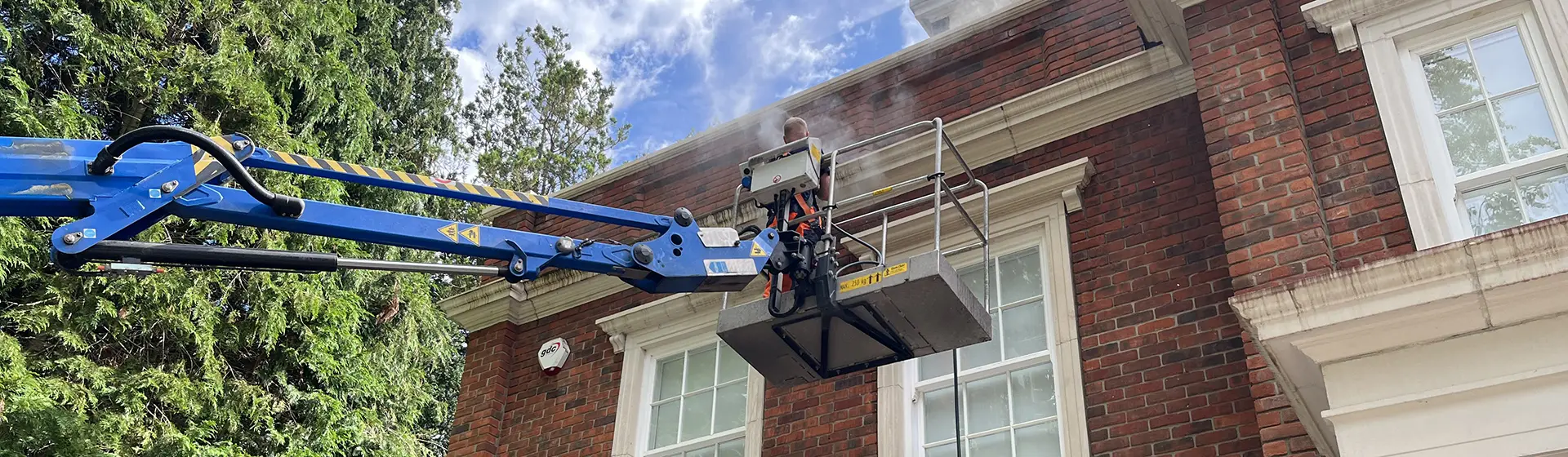
Care that starts with the stone
Water Marsh assesses the stone, its condition and the contamination before recommending a cleaning process. A dense granite surface and weathered Bath stone can need very different treatment, even when the staining looks similar.
We work with homeowners, property managers and project teams to improve the appearance of stonework while retaining its sound material and architectural detail.
Stone types and architectural features
We assess Portland and Bath stone, limestone, sandstone, Yorkstone, granite, marble, travertine and slate. Cast and reconstituted stone need consideration of their composition. Terracotta and faience are ceramic materials, often found alongside masonry, and require their own assessment.
Our work includes:
- Façades and building details: elevations, cladding, ashlar, copings, parapets, cornices and string courses.
- Entrances and surrounds: porticos, pediments, columns, capitals, door and window surrounds, sills, lintels, steps and thresholds.
- Decorative stonework: balustrades, carvings, mouldings, finials, statues, inscriptions and memorials.
- Walls and gateways: boundary walls, retaining walls, gate piers and pier caps.
Projecting ledges, sheltered recesses and intricate carvings collect contamination differently. An ornate façade may therefore require several carefully controlled stages rather than one uniform treatment.
Staining, crusts and biological growth
We assess carbon deposits, traffic pollution, algae, moss, lichen and dark biological staining, together with salts, lime deposits, rust, copper staining and water-run marks. Paint, graffiti, construction residues, bird fouling and deeply absorbed contamination may need separate specialist treatment.
Hard pollution-related crusts, including sulphation and gypsum crusts on some stones, need particular care: the affected surface may itself have changed. Cleaning must be considered alongside the condition of the stone beneath.
Appropriate methods for sensitive surfaces
DOFF steam cleaning may be suitable for certain surface contamination. TORC may be considered for some stubborn deposits and coatings. Specialist treatments or a combination of methods can be appropriate after assessment and testing.
The aim is to achieve a suitable level of cleaning while retaining sound original material. On historic projects, methods and sample areas can be coordinated with the architect, surveyor, conservation professional or main contractor where required.
Repairs & projects
When the stone needs more than cleaning
Flaking, powdering, cracks, open joints, spalling and loss of detail are signs of deterioration, not simply dirt. Fragile areas may need stabilisation before cleaning; damaged stone and failed pointing may require a separately agreed repair programme.
Cleaning cannot replace eroded stone or reconstruct missing carving. We explain those limits so the scope and expected result are clear from the start.
From individual features to commercial façades
We assess small architectural features as well as larger elevations on homes, churches, hotels, offices and managed properties. Access, protection of neighbouring surfaces and the cleaning sequence form part of planning the work.
Send overall photographs, detail views and your postcode for an initial assessment. Include access routes and any known previous treatments or defects.
Your questions
Do I need to know what type of stone I have?
No. Send clear photographs of the building and a close-up of the surface. We can advise on the next assessment step; photographs alone may not establish the material or condition conclusively.
Can delicate carvings and balustrades be cleaned?
Often, subject to their condition. Fine edges, recesses and fragile surfaces require controlled treatment, and a sample area may be appropriate.
Is every black mark carbon pollution?
No. Biological growth and other contamination can look similar. We assess the likely cause before selecting a treatment.
Will cleaning repair damaged stone?
No. It can make defects easier to see, but repairs and stabilisation are separate considerations. We discuss any additional work before it is included in the scope.